Friday, April 15, 2011

From 2500 Years Ago

The greatest evil: wanting more. The worst luck: discontent.
Greed's the curse of life.


To know enough's enough

is enough to know.


-- Ursula Le Guin's translation

Thursday, April 14, 2011

Domino Maze


One of the best toys we had as children was two big tubs of mosaic tiles, the exact size and thickness of dominoes, and with it we'd build mazes all over the house. One, almost finished, was knocked down, much to our dismay, by the wanderings of one of our pet turtles, who was not fazed in the least. A turtle takes the long view.

I've still got some downstairs. If we had wood or tile floors I'd probably make one last maze...after putting the cats in the basement. What made me remember this old homemade toy was a story I heard today:


I ran into a lady in town as she was opening up her arts shop, to whom I've been trying to give our previous hot water heater. Having moved into her parents' old house, she really needs it, but neither one of us has a way to transport it; I needed to tell her we no longer had our landline telephone number. She handed me a little book, of the type with a nature photo on one page and some musings on the opposite one. A local photographer had put it out by herself, like musicians and writers are doing today rather than wasting their time tangling with the publishing or music industries. The author had been preoccupied when bringing the books in a few days earlier, because her parents had lost their home and the electricity to her studio was about to be shut off. The parents had kindly turned their landscaping business over to a younger generation, who had run it into the ground (as it were) and into debt. Due to legal entanglements, the parents were left holding the bag and had to sell their expansive country home, leaving it for a 650-square-foot cabin. In the turmoil, the photographer's mother had forgotten to pay her daughter's utility bills, which she had done while running the accounting end of the landscaping business.


The next day, eight of the eleven books sold, and the photographer had almost enough to pay the bill (wrangling with PP&L Electric about accepting partial payment, of course). And someone had left a $20 bill in her door for a past service -- just enough, in total, to pay it in full.

I thought that life is like a domino maze, and we only see the next one each day -- never the whole scheme. We don't know when some stealthy turtle of fate will knock the whole thing down; we don't see the "Y" fork in the path coming up. It may even be a circle and we'll get hit in the backside soon enough.


But sometimes, you get just what you need.


Tuesday, April 12, 2011

Things You Don't Need to Know


Malibu of the Midwest


For those who have never worn hard shoes, more commonly known as surfers:

If your waves are too salty and not cold enough, or bratwurst isn't available at the beach taco stand, head to Sheboygan, Wisconsin on the shore of Lake Michigan for the biggest freshwater surfing scene in the world. Low pressure systems create favorable winds, rather than tides doing the job, to form swells and waves which get better, unfortunately, as the season advances into winter. There's a surf club sponsored by Blatz Brewery, which is so Wisconsin. When you hit the beach, ask for Doc -- he's been the resident guru since 1976.


For the Graphically Challenged


Two nations, Romania and Chad, have identical national flags. If the coat of arms in the center were removed, tiny Andorra has the same banner also. Someone should have been checking on these things.


Chardonnay, Comrade?


What do Yalta, Crimea, Ukraine and Santa Barbara, California, USofA, have in common? A lot.

Both are tourist destinations, with similar size populations, nestled between sea and mountains. Both enjoy that prince of climates, the Mediterranean, with the attendant vineyards and orchards. The stretch of beach to the northeast of Yalta is even called Santa Barbara, which must sound interesting in the middle of a Russian sentence; this probably stems from their relationship as sister cities since 1987. The geography of their shorelines is a mirror image, and the cities physically resemble each other. If you traveled 6,715 miles from one to the other, you'd still feel right at home.

Monday, April 11, 2011

Stuff

"A house is a pile of stuff with a cover on it." -- George Carlin

No wonder we're so rudderless, so deprived of any intelligent leadership: George is gone. He'll be missed especially because he won't ever be replaced -- his hammer hit the nail squarely on the head. Our heads, rather.


No other generation than ours has had so much disposable wealth to waste, or acquired more stuff, than ours. A blessing with a big curse hidden inside it. Now that we're seeing these old people in the mirror, we come upon the time in life when we must downsize or be hideously inconsiderate and leave the next generations to move it or get rid of it.


Here at Chez Rice, we're trying our level best, but sometimes it's like dipping out the ocean with a 1-cup measure. I've torn into the basement several times, and there's barely one or two more square feet of space freed up. The garage defies me; even with our small car, you have to be oh so careful opening the doors to avoid hitting the treasures and necessities lining three walls. If I could stack stuff against the door and still use it, I probably would. The only thing that redeems the situation is that some people will never get the car into the garage again; when you get to that point, your stuff owns your butt forever.


Because of our numbers and the mountains of stuff we have, selling or giving away some of this loot is becoming harder, according to recent news reports. Even the charity agencies are swamped. A good indicator is that we now see stuff of a quality that never appeared there before. What a conundrum: you can get expensive barely used stuff for very little -- and you don't want more! If the energy and financial crises swamp us, at least we have an awful lot of things already. The trouble is they have little value for barter or sale. Antiques and collectibles are down 40 - 50%; with the internet making things available worldwide that would have taken decades to find previously, the values drop even more precipitously.


Books and studies have been written about how we got into this mess, notably Clive Hamilton's Affluenza -- which I highly recommend. You will be brought up short when you see how people are so easily manipulated by advertising/public relations. If anyone does it right, it's the Italians, who have a concept of bella figura -- cutting a dashing figure; an Old World concept to be sure. The French prescription for affordable style is: a great haircut, a sweater or jacket of very good material, black pants (go with anything) and good shoes. Not a lot of stuff, for every place, time and season; just a look that goes from student to dinner party. We couldn't carry that off, I don't think.


We may lose the war, but we won a battle recently, even though it took 20 years: Nancy and I worked together to clean out, clean and organize the bedroom closet. Hundreds of hangers were extracted; shoes from the 70s went. Needless to say, I found stuff that I'd been missing forever. How Cliff did a whole house cleanout by himself, I don't know. I do know we needed a drink after.


Friday, April 8, 2011

Tyrant or Tool?


Calendars are one of those valuable things you can get for free, like water at fountains, pens, newspapers at airports, or sunshine. OK, I think the airport newspapers are treasures because without them, staring out the window watching the luggage being loaded will drive you crazy by the middle of your second layover.

When you or your offspring are in school, the calendar is a merciless tyrant which pretty much runs your life. I, like you, couldn't wait to get beyond that, and it takes a long time. Afterwards, it's a mix of good and bad: holidays are sprinkled, sparsely, among the months, but if you're employed you likely have to schedule your puny vacation well in advance, and will pine away waiting for it to arrive and miss it for another year after it all-too-swiftly passes by.

We're happy to be in the third stage now, where we're in charge and slipping from the control of institutional powers. Other than setting some appointments with medical professionals to be poked, jabbed or drilled, I now can scan the days of each month with an eye for possibilities rather than duties. Nancy has been with her benevolent employer long enough to have quite the stock of vacation days and no longer gets grief about using them. They say one of the three drivers of happiness is something to look forward to, and the time ahead, clearly represented by neat boxes on the calendar, can be filled with dreams and plans -- and should be.

If we can't find anything new to do, we go back to favorite places and enjoy them from a new angle. The next time we go to the Caribbean, I'd like to try a couples resort, for example. You have to visit a place the first time to learn how to visit it; the next is usually better as you're not spending half the week figuring things out, and you know where the harder-to-find good stuff is.

Just recently, Nancy got a trip to a conference in Las Vegas approved (the previous attempt to attend one in Orlando was shot down at the last minute) and I decided not to waste it like last time: no more joining the roiling masses on the Strip sidewalks and getting lost in the interior shopping mazes for hours after my feet gave out. This time I was going to get out earlier when the crowds were thin and seek out some fun stuff.

So while Nancy dutifully attended her sessions in the far reaches of the Sands conference center (three floors high, a mile long -- nothing's done small in Vegas), I had (monkey) business to attend to.

The weather that week was exceptionally good for March: warmer, sunnier and less windy than usual. That alone, after another northeastern winter that did not have the good grace to leave and make way for Spring, would make a long walk a real pleasure. I headed north to see the Gold & Silver Pawn Shop, featured on the television show Pawn Stars, about 3 miles each way. At the aging end of the Strip, I detoured through the Sahara to see how an older casino hotel was doing, and it was pretty deflated. A few decades of life is all that is allotted in this fast-paced, quick profit, scheme in the desert -- and judging from their faces, that applies to the people as well as the buildings. After that, the blocks looked like Cleveland with scrawny palm trees. Appropriate setting for a pawn shop, come to think of it.

The place doesn't look much like it does on TV; I guess wide-angle lenses are used to good effect to make things look larger and shinier than they are. There was quite a line to get in, so I just scoped it out. The door and windows were covered (one with a black plastic trash bag), and the warehouse in back had a garage door and no windows. A small pickup truck in the side parking lot had a "Chumlee for President" bumper sticker. We could do worse (and might).

The next day I headed off for the light industrial district which parallels the Strip, separated from it by railroad tracks, walls and fences. After a walk about four times longer than I had expected, I found Discount Firearms and Ammo, where I was to meet my little friend, a H&K MP5 9mm submachine gun. The instructor at the indoor range was a former policeman, who showed me the proper stance for automatic fire, after which I let loose. Judging from the results on the target, I have a future in illegal or paramilitary endeavors. You can't do that in New Cumberland!

That night we went just across the street to Gilley's Texas bar and grille, where the food was predictable (but smelled great), then moseyed back to the bar where the cowgirls wore bikinis and chaps (also not doable in New Cumberland), and the bull ride was providing great entertainment as it threw cowgirls and tipsy customers off with equal abandon. Several people used the excellent karaoke setup and did a fine job of it. A very large stage is almost built and will host bands on weekends. All in all, the place was a hoot and was looking to be even better when complete.

The highlight of the week was entry into the hotel's (the Venetian) celebrity nightclub, Tao. It doesn't normally open until 10 PM, but our conference group and two others had it from 7:30 til then. The dark, mysterious Asian bistro/club was packed; it's (along with Mandalay Bay's Rain club) close to the best Vegas has to offer those of us not in the millionaires' sphere. One of the people we sat next to while pillaging the hors d'oeuvre trays that passed by (Kobe beef sliders - oh my) came back from exploring and said we should go to the dance floor. She was right (although we had to leave the Kobe behind): the DJ, the sound system and the lights grabbed all your senses immediately and completely. There were visitors and club professional dancers lined up on top of the low walls which formed a sunken dance area. Did everyone form the letters to "YMCA?" Did strobe lights delight everyone just like in the 60s? Did everyone bust moves they didn't even know they had? You betcha.

So far in this year's calendar, so good. Got all the remodeling projects done before this trip, as planned, and have other events both at home and abroad lined up. Right now, just waiting for Spring...


Tuesday, March 15, 2011

The Electrical Tsunami


The Cretaceous Period in media technology began in 1961 with the introduction of the IBM Selectric typewriter, simply the best of its species. When it reached its maturity as the all-around wonderful Selectric II, it ruled the world for a while before the cataclysm of the Computer Age swept it away. Awesome creature in its day, but its day was over forever.
Some things will endure (horseshoe crabs, crabgrass, crocodiles), some will slowly evolve and adapt, and some disappear over the cliff they didn't see. In 1973, as I was enjoying my last months in the Pentagon, we began testing the IBM 2740 "dumb" terminal, connected to a hulking mainframe computer. We had already adapted from typewriters to "word processing" with the installation of IBM MTST machines, and wondered if this was an add-on or a possibly coming replacement. Like a real tsunami, change was coming in a big way but we hardly suspected it.
Heck, a few years previously, I'd been tearing the news off the clattering AP teletype at WFMV-FM, just like in 1940s movies. Fred Flintstone was about to be pulled, dazed and confused, from the Stone to the Electronic Age.
Likewise, I had no idea that little pillbox-size modem I plugged into our first home computer was a hint of something much more spellbinding than the black-and-white text message boards it led one to. A roller coaster ride is fun and challenging; the anticipation, fast changes and surprises are a thrill. But 40 years of roller coaster rides, one right after another? At some point you start to feel woozy, and wonder if your personal bandwidth is being exceeded.
I'm excited, without the seasickness, by technological advances which solve problems instead of those which are just pretty much about entertainment. And a lot of what's coming at us week after week is just that wickedly effective planned obsolesence washing in on waves of hype.
But we're mostly conformists at heart, and don't want to miss out and become irrelevant, so we open wide and swallow, mindlessly, like baby birds.
While advertising and peer pressure flag us ever forward along on this NASCAR oval of life, sometimes you have to dive for the pits and clear your head. I stopped at CDs and DVDs after getting fooled by the cassette fad, and getting stuck with hundreds of them I can't use anymore. Never did fall for the 8-track (clearly a poor technology) or CB crazes, or plastic Crocs shoes, but that doesn't show any particular presience, evidenced by the stack of dead VCRs in the basement. At least I held on to about half the LP records and my now very old audio equipment. There's a fine line between fuddy-duddy and P. Diddy, and I don't want to be either one.
I can fix a standard electric or gas stove, but our new one has an electronic command center like the bridge of Starship Enterprise. I can't even get much out of the instruction manual. It does do amazing things, but it makes you feel pretty thick. I have a "dumb" phone but it's outsmarted me from day one...
If the electricity goes out for a very long time, there are a host of old skills we should, but don't, have to survive. 3-D surround sound entertainment will seem, all of a sudden, pretty irrelevant. Looking up what you want or need to know on the internet is now so fast and easy it's almost as much a part of our nervous system as breathing. It's been quite a trip, but everything ends (except crabgrass).
The roller coaster comes to a hard stop. You're disoriented; reality has changed in a second. It may be, and it's a scary thought, that there's no school like Old School. Hope you still have a pencil sharpener and index cards.

Thursday, March 3, 2011

A Modest Proposal


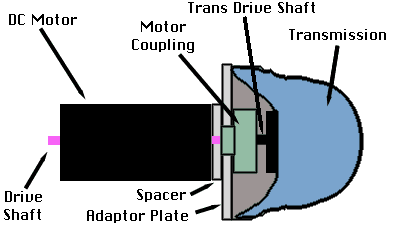
The basic layout for gas-to-electric
conversion
I recently looked at the Exxon-Mobil website to see what they had to say about the energy crisis that's on our doorstep and is, like the Dire Wolf, going to bust in and eat us. They dismissed any concerns about diminishing supply vs. increasing demand, of course. Don't look behind the curtain, Dorothy.
And yesterday, once again it was revealed that Saudi Arabia has published false estimates of their oil reserves. The stability of that regime and of energy industry stock prices depends on continuing the charade. Think Enron here: when it's over, it's over fast.
What to do? Some urbanites can make it without private transportation and avoid gasoline purchases; a very very few make their own biodiesel or ride electric scooters (or horses!), but with our suburban sprawl and 3,000 mile wide geography, the combination of much higher fuel and food prices will knock the less well-off 2/3 of the nation to the floor and they won't have any way to deal with it.
The challenge is urgent, but don't expect a brilliant energy policy from our corporate nation: while the Republicans are cutting millions from alternative programs this very day, China is investing U.S. $15 billion to initiate an electric car industry there. Girl, you got to do it for yourself.
Let's say you now have a good car, not too big, and are worried that if you wait to trade it in on an electric or nongasoline auto when the going gets really bad it will be worthless and the waiting list for that replacement will be long. Remember, though, that innovation comes up from the bottom and not down from the top: it's the eccentric in his garage who will be your hero, not GM or Uncle Sam. For years, hobbyists, hometown engineers and even racing enthusiasts have been developing the conversion of gasoline cars to electric, unheralded but ahead of the giant manufacturers. You won't see it on the evening (or, heaven help us, the cable) news, but a company called Electro Automotive USA sells a complete, universal conversion package for $6500. It might cost that again to hire someone to install it, but you'll have an almost new, really cheap-to-run car for less than half the cost of a new one. And the better-known companies have over a half-dozen production all-electric models ready to go; they're selling in California, Japan, Australia and Asia right now.
Despite the roadblocks being thrown down by the retrograde Tea/Republican't droolers, recharging station systems are going in all over the western and far northern U.S. We covered North America in gas stations in 1920; we can do the same today, scaling it from the local to the continental.
The tipping point will be when the current state of the art battery, the lithium-ion, is replaced by a cheaper, lighter, more effective one. Some only have a range of 30 - 70 miles, which justifiably induces instant "range anxiety," but the Tesla company (which makes the beautiful Roadster, if you have $100,000) is already using laptop battery cell technology with a 245-mile range. Think dial phones vs. the i-Phone -- we can do it. With their serious investment, the Chinese, however, will probably do it first.
But even with the current technology requiring replacing heavy batteries every 3 - 10 years, once you eliminate gas, liquids, filters, belts, hoses, cooling and exhaust repairs and tune-ups, the electric car is cheaper and easier right now.
Those buildings housing your hometown gas stations might be replaced by your neighbors' own new businesses, converting your current car to one that you could actually afford to drive. And not that most people care, but they'd be quiet and clean (if the electric generating plants, owned unfortunately by the very people who don't give a damn about you, the country or the world moved away from coal). And what if other local people installed a few American-made solar panels or a wind turbine on your home, and you generated your own electric fuel. The energy companies could change their business model from extraction to creation and lease these to you (remember, you just spent $12,000 on your conversion; you're a little tapped out) so they could continue to get into your pocket, in a mutually beneficial way.
Just sayin'.